
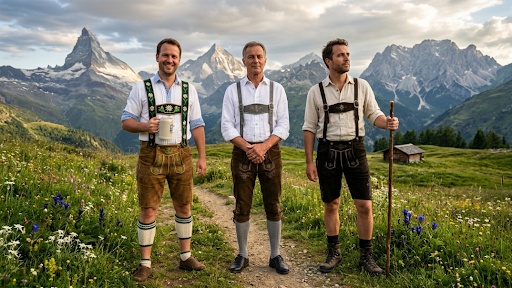
The garment the world calls simply “lederhosen” is actually a family of regional traditions — and the differences between them are real, readable, and historically earned. Bavaria built the version global festival culture knows; Austria’s Alpine states developed their own distinct cuts and detailing; Switzerland’s mountain cantons carried a parallel leather-breeches tradition of their own. For most buyers the regional question is curiosity; for buyers with family heritage, event context, or an eye for the details connoisseurs read, it is the difference between wearing “a” tradition and wearing a specific one. This guide compares the three regional styles honestly — what actually distinguishes them, where the differences show, and how to choose.
Bavarian Lederhosen: The Global Standard
The Style That Defined the Garment
Bavarian lederhosen are the version the world pictures: above-knee shorts (with the knee-length kniebund as the formal alternative) in suede tans through dark browns, with a buttoned drop-front flap, side or rear lacing, and the H-bar suspenders whose decorated crossbar sits at the outfit’s visual center. Munich’s Oktoberfest broadcast this configuration to the planet, making german bavarian lederhosen the reference point every other style is compared against.
The Bavarian Details
Traditional bavarian lederhosen carry a recognizable ornament vocabulary: stitched embroidery of Edelweiss, oak leaves, acorns and stags across the front flap and side seams, typically in greens and creams against the brown hide. Regional Bavarian districts historically refined their own configurations — distinct embroidery patterns and detailing marking a wearer’s home area — a depth that survives today in heritage Trachten circles while general Bavarian styling serves everyone else.
How the Regions Diverged: A Short History
The three styles share one origin story before they share anything else. Leather breeches spread across the entire Alpine arc as working dress — the same practical answer to the same mountain problems, from Bavarian farms through Austrian valleys to Swiss cantons — which is why the garment’s fundamentals (hide construction, front-flap cut, suspension, embroidered reinforcement) are identical everywhere. The divergence came with the nineteenth century’s traditional-dress movements: as regional associations formed to preserve and codify local costume, each area formalized its own version — Bavaria’s districts codifying their embroidery vocabularies, Austria’s states writing their Trachten specifics, Swiss cantons folding leather breeches into their own costume systems.
The historical point carries a practical one: regional differences are real but late — refinements written onto a shared garment, not separate inventions. That is why the styles blend at every border, why quality standards are identical across all three, and why wearing any regional style respectfully honors the same Alpine root. The regions divided the details; the mountains had already agreed on everything else.
Austrian Lederhosen: The Alpine Sibling
Austria’s tradition developed alongside Bavaria’s across the shared Alpine arc, and austrian lederhosen remain their own recognizable style rather than a copy. The tendencies that distinguish them: a strong preference for the knee-length cut in many regions, frequently darker and more muted leather tones, and embroidery that runs finer and more restrained — tonal stitching and tighter motifs where Bavarian work runs bolder and greener. Austrian regional dress codes (the Trachten of Tyrol, Salzburg and Styria among others) each carry their own specifics, and Austrian formal wear pairs the leather with distinctive gray-and-green loden tailoring.
The practical summary for buyers: Austrian styling reads slightly more reserved and formal on average — a register many wearers actively seek, especially in the kniebund cut.
Switzerland Lederhosen: The Parallel Tradition
The Swiss Alpine cantons carried their own leather-breeches heritage — working mountain dress from the same practical roots as their neighbors — and switzerland lederhosen survive today primarily within Swiss folk-costume tradition: regional festival dress, alpine herding culture and heritage celebrations. Swiss traditional dress varies canton by canton, with leather breeches historically featuring in several regional men’s costumes, typically in dark tones with restrained decoration and worn within complete regional ensembles.
For international buyers the Swiss style is the rarest of the three in retail terms — most “Swiss” listings are general Alpine styling — and its main relevance is heritage: wearers honoring Swiss family roots, for whom canton-specific tradition rewards dedicated research.
Reading the Differences at a Glance
Set side by side, the three traditions sort by a few readable signals. Cut tendency: Bavaria leads with the festival short; Austria favors the knee-length; Switzerland’s surviving forms skew longer and formal. Palette: Bavarian tans-to-browns with green-cream embroidery; Austrian darker and more muted; Swiss darkest and plainest. Ornament: Bavarian boldest, Austrian finest, Swiss most restrained. Context: Bavaria owns the global festival stage; Austria balances festival and formal; Switzerland lives chiefly in regional heritage occasions.
And the honest overlap: across lederhosen germany and Austria especially, centuries of shared Alpine culture mean the traditions blend at every border — the differences are tendencies, not walls.
Which Regional Style Should You Choose?
Three buyer situations resolve the question. Attending Oktoberfest or any general festival: Bavarian styling is the event’s native language and the correct default — german traditional lederhosen in the classic Bavarian configuration are what the occasion itself wears. Honoring family heritage: choose the ancestral region’s style, and for Austrian or Swiss roots, the regional specifics (Tyrolean detailing, canton traditions) reward the research — heritage is the one context where region genuinely outranks convention. Seeking a register: Bavarian for classic festival warmth, Austrian for reserved formality — choosing by aesthetic is fully legitimate, since every lederhose germany and Austria produced descends from the same working Alpine roots.
Whatever the region, the quality standard never changes: genuine hide, stitched embroidery, working construction — the Alpine arc agreed on that long before it diverged on anything else.
The Regional Cheat Sheet: Reading Any Pair at a Glance
For quick reference, the regional signals compress into a scannable set. Cut: festival short suggests Bavarian styling; knee-length leans Austrian; longer formal cuts point Swiss and heritage. Palette: warm tans and mid-browns read Bavarian; darker muted browns and greys read Austrian; darkest and plainest read Swiss. Embroidery: bold green-and-cream Alpine motifs are Bavaria’s signature; finer tonal stitching is Austria’s; minimal restrained work is the Swiss tendency. Ensemble context: paired with gingham and festival styling, Bavarian; with grey-green loden tailoring, Austrian; within complete regional costume, Swiss.
Two honest caveats keep the cheat sheet honest. Modern retail blends freely — most commercial pairs are general Alpine styling drawing on all three vocabularies, which is fully legitimate for festival wear. And the signals are tendencies, not laws: centuries of shared borders produced every crossover imaginable. Use the sheet to read register and reference tradition, not to police anyone’s outfit — least of all your own.
Beyond the Big Three: The Wider Alpine Family
The three headline regions don’t exhaust the tradition’s map. The Alpine arc’s border regions carry their own blends — South Tyrolean dress mixing Austrian and Italian Alpine threads, Allgäu and Black Forest areas adding southwestern German character to the Bavarian base — while emigration carried the garment worldwide: German and Austrian diaspora communities from the American Midwest to Brazil maintain Trachten traditions generations deep, complete with their own festival calendars and gently localized styling. For buyers, the wider family carries one practical meaning: the “general Alpine” styling that dominates modern retail is not a dilution but the tradition’s own lingua franca — the shared vocabulary every region contributes to and every festival understands. Regional specificity remains available for those whose heritage or Trachten-association membership calls for it; for everyone else, the common Alpine register is exactly what it has been for a century: the way the whole family dresses when it gathers.
Frequently Asked Questions
What’s the difference between Bavarian and Austrian lederhosen?
Tendencies in cut and detail: Bavaria favors the festival short with bold green-cream embroidery; Austria leans knee-length, darker-toned and more finely restrained.
Are lederhosen German or Austrian originally?
Both — the garment arose as working dress across the shared Bavarian-Austrian Alpine region, with each side developing its own regional styles from the common root.
Do the Swiss wear lederhosen?
Leather breeches feature in several Swiss cantonal folk traditions — a parallel Alpine heritage worn today mainly at regional festivals and heritage occasions.
Which style is right for Oktoberfest?
Bavarian — the festival’s native tradition. Classic Bavarian styling is the default the event itself is dressed in.
Does regional style matter more than quality?
Never — genuine hide, stitched embroidery and working construction are the shared Alpine standard. Choose region for heritage or register; choose quality always.
Can you mix regional lederhosen styles?
Freely — modern festival wear blends the vocabularies constantly, and general Alpine styling is fully legitimate. Strict regional configuration matters mainly in heritage and Trachten-association contexts.
How do I know which region my lederhosen are from?
Read the signals: cut length, leather tone and embroidery character — then check the maker’s own description, since most commercial pairs are deliberately general Alpine rather than region-specific.
Three Traditions, One Garment
Bavarian lederhosen gave the world the icon; Austria refined its own quieter register beside it; Switzerland carried the parallel mountain tradition in its cantons — three regional answers to the same Alpine question, readable in cut, palette and stitchwork once you know the signals. Choose Bavaria for the festival, your ancestry for heritage, your eye for register — and wear whichever answer you choose to the one standard all three regions share: the real thing, properly made, exactly as the mountains intended.
 Engrnewswire