
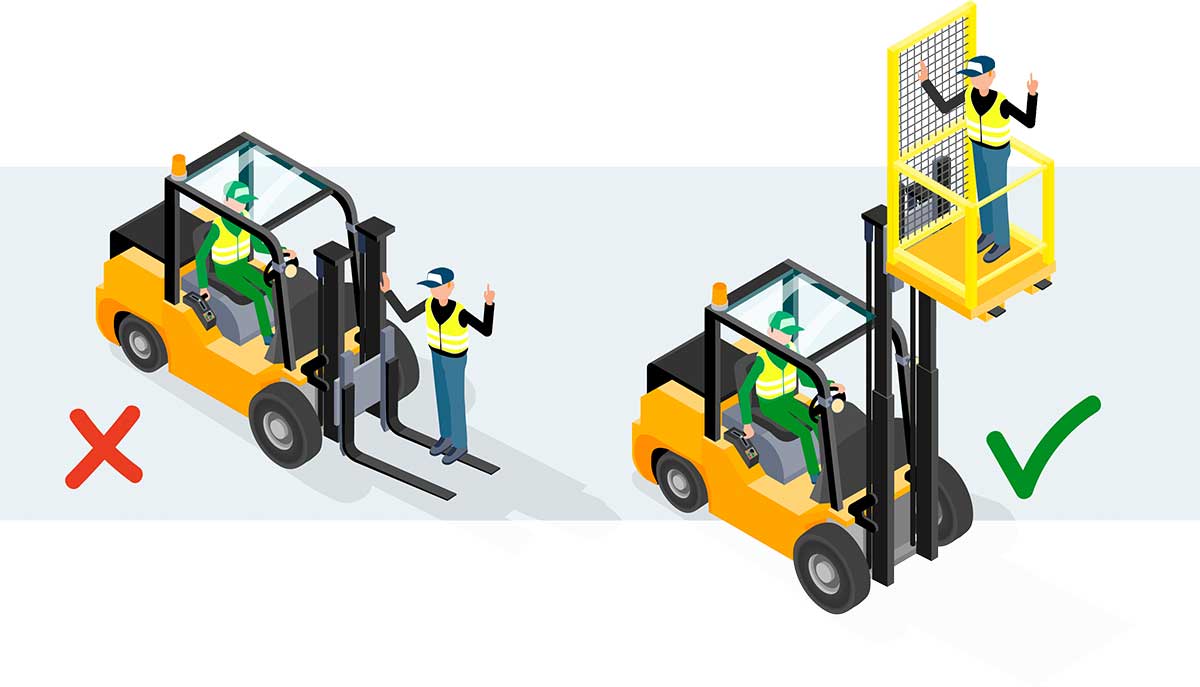
A pallet cannot fall, and that is the whole difference
Warehouses, lumber yards and municipal shops across Canada already own the machine that can reach a high shelf or a failed light fixture: the forklift in the yard. Fitting it with a TMG Industrial forklift work platform turns that reach into access for a worker, and the moment a person stands on the forks, every assumption the machine was designed around changes. A pallet that shifts is a loss; a person who shifts is an injury.
That is why a forklift man basket is treated as a separate class of attachment rather than another set of forks. It is not stronger steel that makes it acceptable; it is the guarding, the attachment method and the operating rules that come with it. Understanding why each of those exists is what separates safe occasional access from an improvised lift.
The load chart stops being about weight alone
A forklift’s rated capacity is quoted at a standard load center, usually twenty-four inches from the face of the forks. Hang the weight farther forward and the truck can carry less, because the load and the counterweight sit on opposite sides of the front axle. A platform pushes that center forward before anyone steps on.
The rated capacity of the forklift man basket itself is a separate number. An 880 pound rating covers the occupants, their tools and anything set on the deck, not body weight alone. Two workers with a toolbox and a length of conduit reach that figure faster than most people expect, and no quiet margin is built in for the extra.
Where the stability triangle puts its limits
A counterbalanced forklift stands on a triangle rather than a rectangle: the two front wheels and the single pivot point between the rear wheels. Stability means keeping the combined center of mass of truck, attachment and load inside that triangle, and the triangle is at its narrowest toward the back.
Raising a load does not change its weight, but it does raise that combined center of mass, so the same small tilt of the frame moves it much farther sideways. A slope, a pothole or a soft shoulder that a loaded truck would shrug off becomes the thing that matters once a person is elevated. This is why traveling with a raised platform is prohibited rather than merely discouraged.
The platform has to be part of the forklift, not a passenger
A platform that only sits over the forks can slide, and the fork tips can walk out of their pockets when the carriage tilts forward. A locking mechanism, a retaining pin or a chain back to the carriage removes that possibility, which is the reason the securing step is never optional.
The geometry of the pockets matters as well. Pockets sized close to the fork section stop the deck from rocking side to side, and a deck that sits low over the fork heels keeps the standing surface as close as possible to the carriage. Both details reduce how much movement a worker feels at height, which has a real effect on how carefully they work.
Before each use the attachment deserves the same glance a sling would get. Cracked welds at the rail joints, a bent or missing retaining pin and a gate that no longer latches are the three findings that take a platform out of service, and all three are visible from the ground in under a minute.
What actually keeps a worker inside the cage
Falls from a forklift man basket, rather than failures of one, are the hazard the guarding addresses. Each element does one specific job, and borrowing any of them for convenience takes the whole system out of compliance:
- Guardrails: a barrier at roughly waist height
- Toe boards: stop tools sliding off the deck
- Self-closing gate: no open side at height
- Anchor point: a tie-off for a harness lanyard
- Overhead guard: cover against anything dropped above
A harness still matters inside a guarded cage, because the realistic hazard is being thrown against the rail rather than stepping over it. A short lanyard clipped to the designated anchor, not to the mast or whichever rail is nearest, is what limits how far a worker travels if the truck lurches.
What the operator at the controls is responsible for
The driver does not become a spectator once the deck is up. Someone has to stay at the controls with the brake set, because an unattended forklift can creep, and a worker at height has no way to correct it. Signals have to be agreed before the lift, since a person on the deck cannot see what the wheels are doing.
Two smaller habits carry a surprising amount of weight. Ground checked for level before the platform goes up, rather than after, removes most of the instability people later blame on the attachment. Lowering fully before anyone climbs out prevents the long step down that quietly causes more injuries than the lift itself.
Where this kind of access work is heading
A forklift man basket belongs to a narrow band of work: occasional, short-duration access where a purpose-built lift would stand idle most of the year. Forklift attachments are usually chosen on exactly that logic, because the carrier machine is already bought and maintained. For daily overhead work the direction of travel is toward self-propelled elevating platforms, which are built for the task and do not borrow their stability from a counterweight. Rental fleets have made that option cheap enough that the arithmetic now favors them for anything measured in days rather than minutes.
For everything in between, the decision comes down to matching the attachment to the truck that will carry it. TMG Industrial specifies its forklift safety cage by deck size and rated load, and the three numbers worth lining up are the platform rating, the fork pocket dimensions and the capacity your own machine still has once the load center moves forward.