
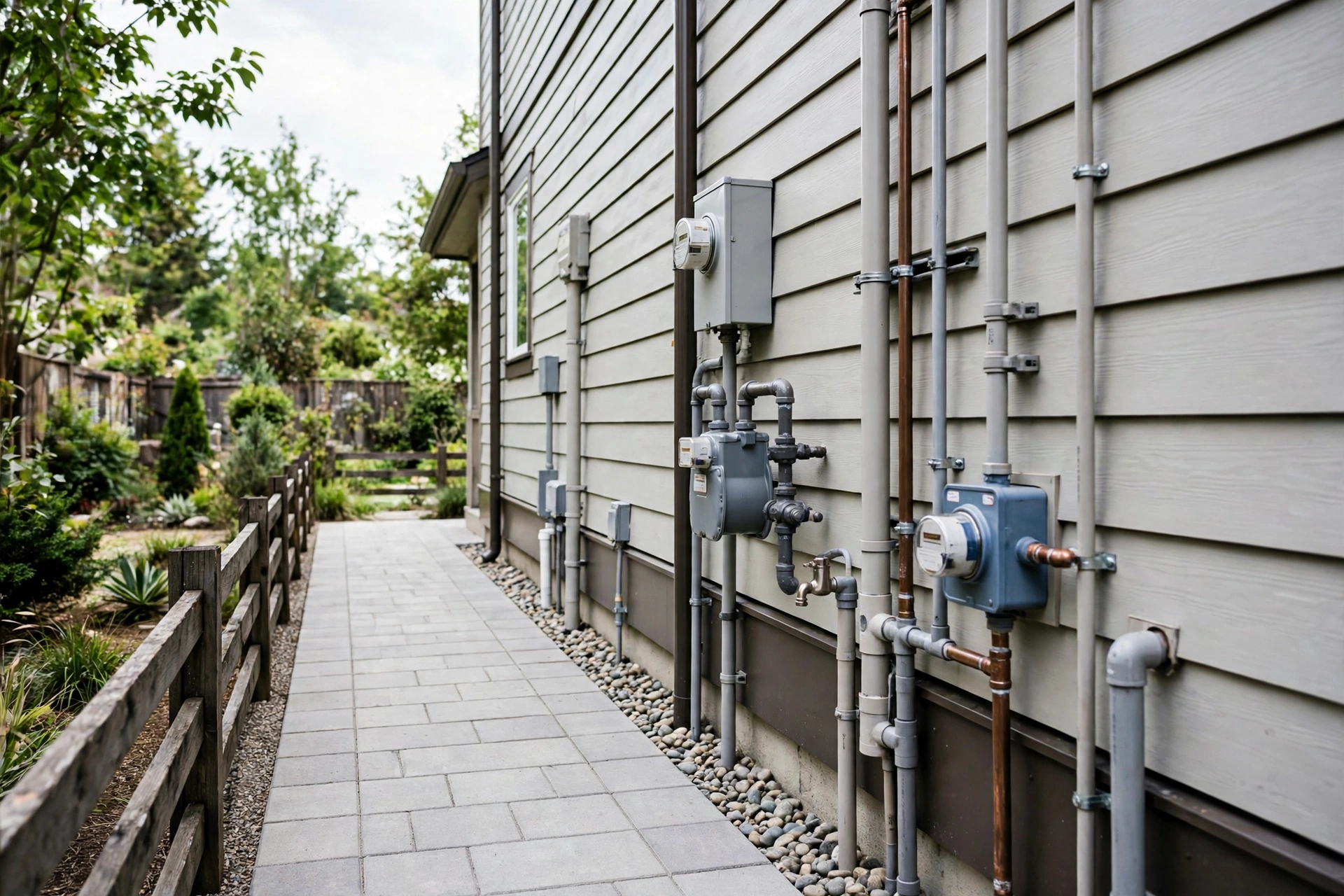
Every house has a side that nobody photographs: the strip of ground where the gas meter, the electrical panel, the water shutoff, and the air conditioning disconnect all live, usually behind a bush, down a muddy path, or under a pile of garden tools. An exterior service corridor turns that neglected strip into a deliberate, low-maintenance route — a clear, drained, lit path that lets you, a meter reader, or an emergency responder reach every utility connection in any weather, without trampling the garden or hunting for a shutoff in the dark.
Why Utility Access Gets Harder Every Year You Ignore It
Utility connections do not stay accessible by themselves. Shrubs planted as small specimens grow into the meter box, ground cover creeps across the path, a downspout starts discharging across the walkway, and the gate that once swung freely now sticks on a raised root. Each change is small, but together they turn a thirty-second job — reading a meter or shutting off the water — into a ten-minute obstacle course, and in an emergency those minutes matter.
The cost of poor access shows up in other ways too. A technician who cannot reach a meter cleanly may estimate the reading instead of taking it. An electrician called for an urgent fault loses time clearing a path before the real work starts. And when a water leak needs the main shutoff closed in a hurry, a buried or hidden valve can mean the difference between a mop-up and a flood. A service corridor is cheap insurance against all three, and it is built once rather than fought over every year.
What an Exterior Service Corridor Actually Is
A service corridor is a defined, maintained strip of ground — typically three to four feet wide — that runs along the side of the house past every utility connection, surfaced with a hard, free-draining material and kept permanently clear of planting, storage, and obstructions. It is not a driveway and not a garden path; it is working space, designed for boots, barrows, and ladders rather than for looks, though a well-built one looks tidy precisely because it is uncluttered.
The corridor has four jobs: it gives every connection a clear approach, it keeps the ground dry underfoot, it protects the connections themselves from damage and concealment, and it marks the route so clearly that nobody — not a delivery driver, not a landscaper, not a future owner — mistakes it for storage space. Where a utility easement crosses the property, the corridor usually follows the easement line, because that is where the infrastructure already runs and where access rights already exist.
Choosing the Corridor Route: Along the Wall, Around the Side, or Across the Yard
Most homes need only one corridor, and the obvious route is usually the right one: along the wall that already carries the meters and panels. Walk the house and note where each connection sits — the electrical service entrance, the gas meter, the water main, the sewer cleanout, the air conditioning disconnect — and draw the shortest line that passes them all without crossing a patio, a vegetable bed, or a play area. The corridor should start at a gate or driveway and end at the last connection, with no dead ends.
Side yards are the natural home for a corridor, because that is where builders put the services in the first place. A rear-yard route makes sense when the main connections sit at the back, and a front-yard corridor is worth building when the meters face the street and readers arrive regularly. Whichever side is chosen, the route must stay on the homeowner's land and clear of any recorded easement restrictions — and if the corridor crosses a neighbour's easement or a shared boundary, check the easement document before laying a single slab.
How to Lay Out the Corridor So Every Connection Stays Reachable
Layout is a measuring exercise, not a guess. Mark the centre line of the corridor with string, then check the clearances at every connection: a meter reader needs room to stand squarely in front of the meter, an electrician needs space to open a panel door fully, and a shutoff valve needs room for a hand and a wrench. Anything that forces a worker to stand sideways or reach across a bush is a layout failure, however tidy the corridor looks.
- Keep the corridor 3 to 4 feet wide, so a person with a toolbox and a ladder can pass comfortably.
- Leave at least 3 feet of clear working space in front of every meter, panel, and shutoff valve.
- Position the corridor so panel doors and meter covers open fully without hitting a fence or a wall.
- Keep the route level or gently graded, with no steps, so barrows and ladders move easily.
- Mark the corridor edges with a low stone border or steel edging, so planting and mulch cannot creep back in.
The working-space rule is the one to be strict about, because it is the rule utility companies enforce. A gas meter boxed in by shrubs will be flagged by the meter reader, and an electrical panel blocked by stored timber is a code issue in most jurisdictions. Three feet of clear space in front of every connection is a small price for a corridor that never gets a warning notice taped to the gate.
Surfacing That Survives Boots, Barrows, and Weather
A service corridor lives or dies by its surface. Grass turns to mud in the first wet winter, bare soil erodes and leaves the meter plinth exposed, and loose mulch migrates onto the path and into the drain. The right surface is hard, free-draining, and easy to sweep: concrete pavers on a compacted base, compacted gravel over landscape fabric, or a single run of large stepping slabs with gravel joints. All three survive frost, drain rainwater, and can be lifted and relaid if a buried service ever needs digging up.
| Surface | Cost and effort | Drainage | Best for |
|---|---|---|---|
| Concrete pavers on compacted base | Medium cost, one weekend | Excellent with open joints | Main corridors used all year |
| Compacted gravel over fabric | Low cost, one day | Excellent, fully permeable | Long runs and utility easements |
| Large stepping slabs with gravel joints | Medium cost, one day | Good | Narrow side yards and meter approaches |
| Poured concrete strip | Higher cost, needs curing | Needs a fall to drain | Permanent routes with heavy barrow use |
| Grass or bare soil | No cost | Poor — turns to mud | Avoid for any service route |
Gravel deserves a special mention for corridors that cross utility easements. Because it is not a permanent structure, it rarely conflicts with easement restrictions, and it can be scraped aside in minutes if a utility crew needs to dig. Pavers are the better choice where the corridor runs beside the house itself, because they give a firm footing for ladders and stay level for years. Whichever surface is chosen, lay it with a slight fall away from the house wall so rainwater runs off the corridor rather than pooling against the foundation.
Keeping Meters, Shutoffs, and Panels Clear and Labelled
A corridor only works if the connections on it stay visible and reachable. Every meter, shutoff, and panel should be labelled in plain language — 'Main water shutoff', 'Gas meter', 'AC disconnect' — with labels that survive weather, and the labels should be readable from the corridor without moving anything. A simple engraved tag or a laminated card inside a small weatherproof holder outlasts a marker-pen note by years.
- Label every shutoff and meter in plain words, not codes, so anyone can find the right one in an emergency.
- Photograph the labelled connections and keep the photo with the house documents for future owners.
- Fit a small weatherproof light above the main panel and shutoff cluster for night-time access.
- Keep a laminated corridor map inside the house showing where each connection sits and what it controls.
The night-time point is easy to overlook and expensive to regret. Emergencies do not wait for daylight, and a shutoff that is obvious at noon is invisible at midnight without a light. A single solar or motion-sensor light over the main cluster costs very little and turns a panicked search into a thirty-second walk. Check the light twice a year, when the clocks change, and replace the battery before it fails rather than after.
Planting Rules: What Grows Near Utilities and What Never Should
Planting is where most service corridors quietly fail. A shrub planted a foot from a meter grows into it within three seasons, and a tree planted over a buried service line sends roots into the pipe joint within a decade. The rule is simple: nothing tall, nothing deep-rooted, and nothing thorny within the corridor and its working spaces. Low ground cover and small ornamental grasses are fine beyond the corridor edge, provided they are kept trimmed and cannot flop across the path.
Utility easements carry the strictest planting rules of all, and they are legally binding. Deep-rooted trees and large shrubs are typically prohibited inside an easement because roots crack, shift, and infiltrate buried pipes, and fences or structures that block equipment access are off-limits. Shallow ground cover, flower beds, and mown grass are generally acceptable, because they do not interfere with access or damage the infrastructure. Before planting anywhere near a service line, check the easement document and confirm the utility's clearance requirements — a tree planted in the wrong place can become a costly removal order.
Drainage and Lighting Along the Corridor
A corridor that holds water is worse than no corridor at all, because it channels mud straight to the meters it was built to protect. Grade the corridor surface to fall gently away from the house wall and toward a lawn or a drain, and never let a downspout discharge onto the corridor itself — extend downspouts past the corridor edge or connect them to a solid drain line. A shallow gravel trench along the outer edge of the corridor catches runoff before it can pool on the walking surface.
- Fall the corridor surface away from the house at a gentle gradient so water never ponds against the wall.
- Keep downspouts and air conditioning condensate drains discharging clear of the corridor.
- Fit a motion-sensor light over the main connection cluster and at the corridor entrance.
- Clear leaves from the corridor monthly in autumn, so wet leaves do not hide the surface or block the drain.
Lighting and drainage work together in winter, when the corridor is most needed and least forgiving. A frozen puddle on a service path is a slip hazard for the homeowner and a barrier for the meter reader, so the fall and the drainage matter most in the cold months. A bag of grit kept in a small weatherproof box at the corridor entrance is a modest addition that earns its place the first icy morning it is needed.
Easements and Boundaries: What You May Not Build On
Before building anything permanent in a service corridor, check whether a utility easement crosses the route. An easement is a recorded corridor of land — commonly 10 to 30 feet wide on residential lots — reserved for utility access, and it runs with the land to every future owner. The homeowner still owns the land, but cannot build anything inside the easement that obstructs access to the pipes, cables, or equipment beneath it: no garages, sheds, decks, patios, or retaining walls, and no deep-rooted planting or fences that block equipment.
The practical consequence is that a service corridor crossing an easement should be surfaced with removable materials — gravel or pavers rather than poured concrete — and kept free of permanent structures. If a utility crew ever needs to excavate, they will lift the surface and restore it, but a poured slab or a shed in the easement becomes the homeowner's expensive problem. Check the property deed and the easement document before construction, and when in doubt, ask the utility company — a five-minute call is cheaper than a demolition notice.
Exterior Service Corridor FAQs: Reaching Your Utility Connections
How wide should an exterior service corridor be?
Three to four feet is the practical width for a residential corridor: wide enough for a person carrying a toolbox or a ladder, and narrow enough to fit a side yard without swallowing the garden. Leave at least three feet of clear working space in front of every meter, panel, and shutoff, since that is the space a worker needs to operate the equipment safely.
Can I pave over a utility easement?
Usually not with anything permanent. Most easements forbid structures that obstruct access, which includes poured concrete, sheds, and decks. Removable surfaces such as gravel or pavers are generally acceptable because a utility crew can lift them to dig. Always check the recorded easement document first, because its wording governs what is allowed.
What should I do if a meter is hidden behind planting?
Cut the planting back immediately and keep it back. A meter hidden by shrubs will be flagged by the reader, and in an emergency a hidden shutoff wastes critical minutes. Replace tall planting near meters with low ground cover, and fit a small stone or gravel apron around the meter so nothing can grow back against it.
Do I need permission to build a service corridor?
A simple gravel or paver corridor on your own land rarely needs a permit, but check two things first: whether a utility easement crosses the route, and whether local rules cover hard surfacing near boundaries. If the corridor touches a shared boundary or a public footway, a quick call to the local authority settles the question.
How do I keep the corridor clear in winter?
Grade the surface so water drains away instead of pooling and freezing, keep a bag of grit in a weatherproof box at the entrance, and clear snow by hand after each fall. Never pile cleared snow against the meters or the panel — stack it on the lawn side, where meltwater drains away from the corridor.
Final Thoughts: A Clear Path to Every Connection
A service corridor is one of the least glamorous improvements a house can have, and one of the most useful. A clear, drained, lit path past every meter, shutoff, and panel means no more hunting through shrubs for a valve, no more muddy boots to read a meter, and no more panicked searching in the dark when something goes wrong. Build it with removable surfacing where easements run, label everything in plain words, and keep the planting low and the lighting working. The corridor will quietly do its job for decades, and the first time you need it in a hurry, you will be glad it is there.
 Peregrine