
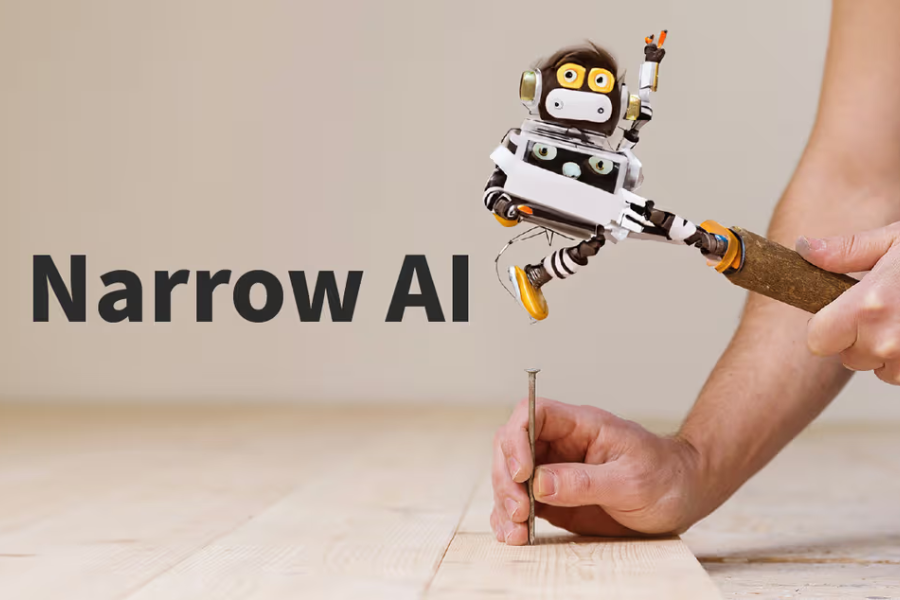
Nothing makes me happier than Netflix recommending a movie or a show that matches my taste. Or, Siri ordering groceries or making a phone call without me lifting a finger. All these, and many other tasks, bring convenience via artificial intelligence.
If I were to be more specific, it’s the artificial narrow intelligence, also known as the “Narrow AI” or “Weak AI.” It wouldn’t be an overstatement to say that Narrow AI is the driving force behind all the recent developments in AI.
In this article, I’ll explain what Narrow is, how it works, and bring convenience to our lives. So, let’s get started:
What is Narrow AI?
It is the only type of AI that exists today. All the other types, such as artificial general intelligence (AGI), super AI, etc, are purely theoretical.
Narrow AI specializes in completing a specialized set of tasks. It is widely used in robots, gadgets, software, search engines, etc, that are designed to perform definite tasks. For instance, Siri, a smart home assistant, cannot generate pictures, and Netflix’s AI-powered recommendation engine won’t be able to make a phone call via voice commands.
To achieve this, Narrow AI leverages machine learning (ML), natural language processing (NLP), and neural networks. However, it is worth noting that anything utilizing Narrow AI cannot learn or work beyond its scope.
Narrow AI can learn with time and improve its response to make it more personalized. This task limitation is also the primary reason why Narrow AI is referred to as weak AI.
How Does Narrow AI Work?
Narrow AI does not possess any consciousness. It cannot decide its actions and, rather, follows a pre-determined approach that is based on the analysis of the large datasets. The set of rules it follows dictates that it answers queries by matching the users’ prompts.
For instance, Siri is designed to complete tasks. However, if you share any personal or emotional experience with it, it gives vague or random answers. Simply because it can neither think on its own nor decide its actions, as they’re based on your commands.
Additionally, Narrow AI is designed to complete one action at a time. And, it is limited to a set of tasks and cannot operate beyond its scope. It might seem major limitation of Narrow AI. But it completes the assigned task with extreme efficiency and can work around the clock without getting tired.
For instance, I run a small marketing agency and use ChatGPT to research, write, and proofread content, and brainstorm ideas. Now, with the help of my high-speed and reliable home connection, AT&T WiFi, and clear and detailed prompts, ChatGPT can instantly generate the results I want.
What are Benefits of Narrow AI?
Narrow AI has several applications, such as:
Foundation For More Sophisticated AI Models
As I mentioned earlier, Narrow AI is the only practical form of AI that exists today. And, it wouldn’t be wrong to say that it is largely contributing to achieving more intelligent AI models. Narrow AI can provide much-needed computational power and data processing capabilities to create advanced AI models.
Task Automation
It is one of the most significant advantages of Narrow AI. It relieves humans from mundane tasks and brings much-needed convenience. For instance, I’ve already mentioned above that Siri orders groceries for me. And just like that, dozens of Narrow AI models are available that are designed to automate hundreds of tedious tasks.
Quick Data Processing
Narrow AI specializes in processing large datasets and can derive useful information from them. Be it summarizing a large document or conducting thorough research, Narrow AI can help us in several ways. And, not only does it reduce human error, but it can also help us make faster and informed decisions.
What are Limitations of Narrow AI?
Though it is the only physical form of AI available today, it is still in the development phase and poses some challenges, such as:
Lack of Cognitive Intelligence
Narrow AI lacks self-awareness and can only generate results based on your queries. Also, while it might feel that Narrow AI can think on its own, it can’t. It only analyzes the users’ prompts, matches with the datasets it was trained on, and generates results accordingly. To simplify complex AI concepts, an infographic maker can help present key ideas, use cases, and comparisons in a clear and visually engaging format.
Reliance on Data
It’s well-established that without large datasets, Narrow AI is useless. However, even if there’s a fraction of bias or error in the training data, it can impact the overall quality and eventually the results produced by a Narrow AI model.
Inability to Adapt
Narrow AI cannot expand its scope on its own. It requires a large dataset and extensive training to perform more functions. However, even if a Narrow AI model increases its expertise, it might still fail to complete two actions simultaneously.
Frequently Asked Questions
Do autonomous vehicles also use Narrow AI?
Yes, autonomous vehicles also use Narrow AI for different functions, such as sensing objects around them.
How is AGI different than Narrow AI?
AGI is a hypothetical model that can think, understand, and act like a human. However, a Narrow AI model can only complete tasks it’s designed for.
Keep an eye for more latest news & updates on Image Fap!
 Engrnewswire
  Nathan